
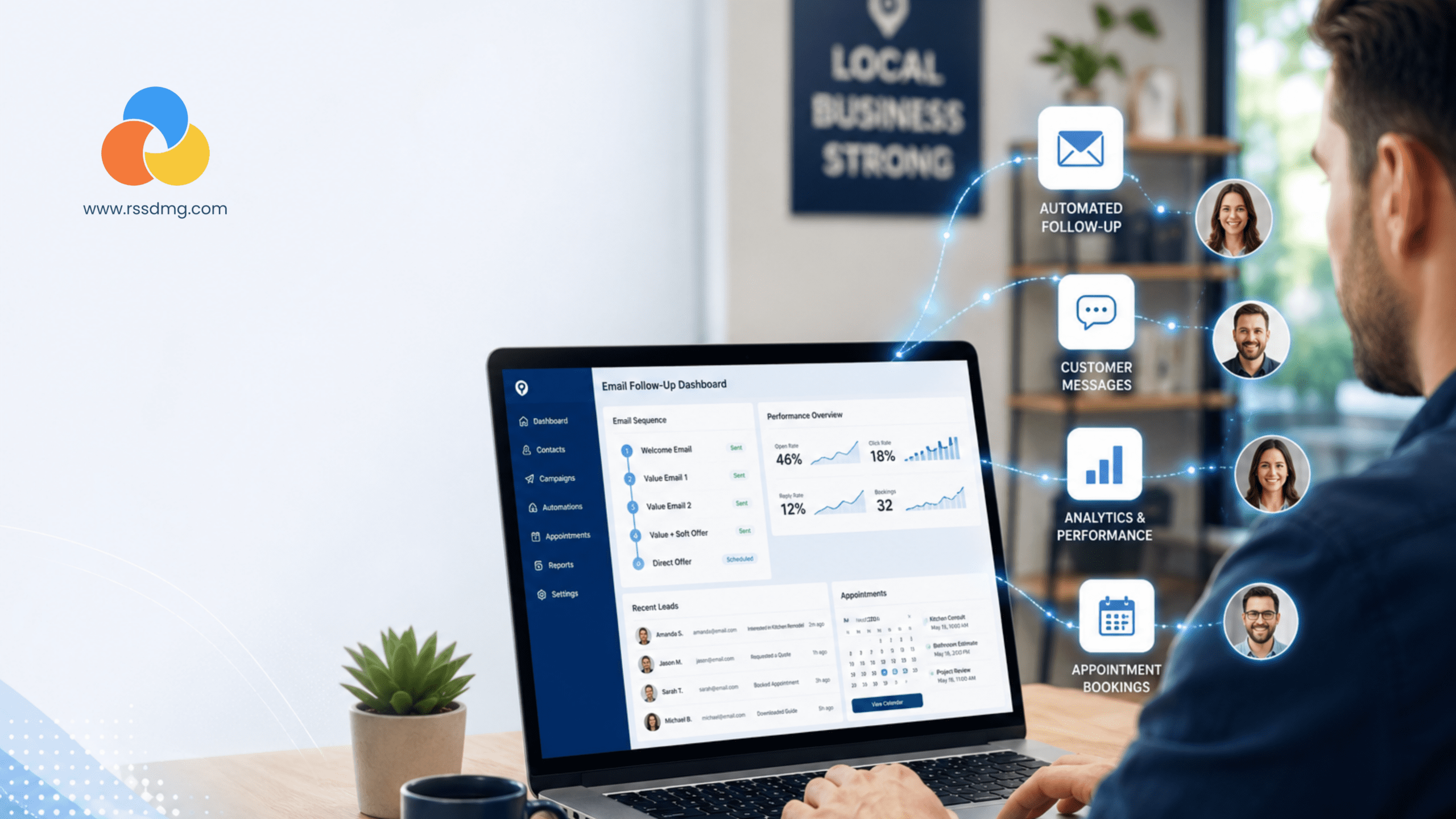
In our previous articles, you learned how to attract visitors, create lead magnets, and capture email addresses (see our primer on turning web visitors into customers). Now comes the step that turns interest into work: simple, consistent follow-up.
Quick definition: In this guide, follow-up means the messages you send after someone gives you their contact information. It starts with a short, automated email sequence and continues with a consistently timed email newsletter. If a lead demonstrates strong interest and you have their permission, your follow-up can also involve a quick phone call or a confirmation text message.
Follow-up matters more than the initial capture, because most local buyers aren’t ready to make a decision the day they join your list. They spend a few days or weeks researching what they need, how much it costs, and whom to trust, and they wait for a convenient time to move forward. Your emails keep you visible and useful during that window, answering common questions and a simple next step, so you’re the obvious choice when they’re ready.
Why Follow-Up Matters More Than Initial Capture
Capturing an email permits you to communicate with the sender. Follow-up earns trust and moves people forward. Without it, your list sits idle, and people forget you. With it, you guide them through common questions, reduce friction, and make the next step obvious: request a quote, book an appointment, or schedule a consultation.
Think of follow-up as the bridge between interest and action. Local buyers often compare two to four options, ask friends for referrals, and wait for a convenient window. Your messages keep your name top of mind during that window and reduce decision fatigue by answering what matters most.
Trust grows with small, consistent touches. Deliver a useful resource, answer some questions, show local proof points, and invite a simple next step. Each contact should feel like progress, not pressure.
You can tell your follow-up is working when you receive more replies with specific questions, see a faster turnaround from first contact to booking, and have fewer prospects choosing a competitor because they couldn’t reach you.
Sequence, Timing, and Frequency
Keep your sequence simple and tie timing to how your buyers decide. A straightforward five-email structure works for most local businesses:
- Welcome (Immediate): Deliver the resource, explain what comes next, and invite questions.
- Value Email 1 (2-3 days later): Answer a common question related to the lead magnet.
- Value Email 2 (5-7 days later): Share a short local example or case study with results.
- Value Email 3 + Soft Offer (10-14 days later): Provide a checklist or tip sheet and invite a low-friction next step.
- Direct Offer (3-4 weeks later): Make a clear invitation to schedule, request an estimate, or book a meeting.
Adjust spacing for your typical buying cycle. If your service is fast-moving, limit it to 4 emails over 2 weeks. If decisions take longer, keep five emails but spread them across four weeks.
In most cases, follow-up emails do the heavy lifting. Write and schedule them once, then improve them over time based on results. Personal replies and calls are reserved for leads who ask for help, request pricing, or click booking links more than once.
Subject line ideas for each step:
- Welcome: Your guide is inside, plus a quick tip for [city]
- Value 1: The most asked question about [service] in [city]
- Value 2: How we helped a [neighborhood] homeowner save time
- Value 3: Quick checklist before you request pricing
- Direct Offer: Ready for a quote? Here is the easy way to schedule
After this five-email sequence, move subscribers to your regular cadence and continue sending helpful information.
Cadence after the sequence: Monthly emails are a safe baseline for most local services. Bi-weekly can work if you consistently have useful content. If your unsubscribe rates rise or open rates drop for several emails in a row, reduce frequency and improve relevance. Consistency builds trust. If you promise monthly emails, send monthly emails.
Time of day and seasonality: For home services, the early evening often works, as homeowners check their email after work. For professional services, morning sends between 8 and 10 can perform well. Test two time slots for two weeks and choose the winner. Increase frequency slightly before busy periods, then return to baseline after demand normalizes. Avoid long gaps. If you go quiet for more than 60 days, reintroduce yourself with a short note that offers one helpful resource and a clear way to reconnect.
What to Write in Follow-Up Emails
Write short, specific messages that answer real questions and point to one next step. Use local context, such as city names, typical pricing ranges, timelines, or seasonal factors, so your emails feel relevant. If you want help sharpening local relevance across your site, see our guide to on-page SEO for local businesses.
Each email should:
- State a clear benefit in the first sentence.
- Keep content brief and scannable.
- Include one simple action (reply, view an example, schedule)
- Add a small proof point (result, quote, or photo). Positive reviews matter here; learn how to build and use them in ou local reviews guide.
Examples by industry:
- Construction and Home Services: “Three things to decide before requesting a kitchen estimate: timeline, layout, finishes.”
- Medical and Wellness: “Desk stretches that actually help: two short videos for lower back relief.”
- Professional Services: “What to bring to your first consultation: documents, timelines, and questions.”
- Salons and Personal Services: “How to describe the cut you want: photo guide and stylist tips.”
Use plain language and avoid jargon. Replace terms like ‘scope of work’ with a simple description, for example, what we plan to do and how long it will take.
Personalize lightly with what you know: city, neighborhood, service type, and any notes they provided when they opted in. Over-personalization can feel intrusive; stick to the context they gave you.
Include a short P.S. that restates the next step. For example, P.S. If you want a quick estimate, reply with square footage and timeline.
Keep images small and purposeful. One photo of a local project or a clean checklist graphic is enough. Large galleries slow load time and get clipped in inboxes.
Unified email templates you can copy and adapt:
Welcome template
Subject: Your [lead magnet] is inside
First line: Here is your [guide], plus one tip that saves time in [city].
Body: Link to resource, one actionable tip tied to local context, and an invitation to ask a question.
Proof point: One short local result or quote.
CTA: Reply with your timeline for a quick recommendation.
Direct offer template
Subject: Ready to book, choose a time that works
First line: If you are ready, pick a convenient slot for a quick estimate or consultation.
Body: One sentence that frames the benefit, links to your scheduling page, and provides reassurance that there is no obligation.
Proof point: A concise local example: last month, [number] [city] customers booked through this link.
CTA: Schedule now or reply with a question.
Measuring What Works
Track basic metrics and adjust based on what you see:
- Open Rates: 20-25% is typical for local businesses
- Click Rates: 3-5% is common for helpful, focused emails.
- Reply Rates: Signals strong intent; invite replies with simple prompts.
- Unsubscribe Rates: Keep under 2% per email
- Conversions: Lead-to-consultation rate, lead-to-customer rate, time-to-conversion, and revenue per lead
If an email underperforms, tighten the subject line, make the opening sentence more specific, reduce it to one clear call to action, and add a local example. Test changes for two weeks before making additional adjustments.
Go one level deeper with tracking:
- Tag each link with a simple code that shows which email drove the click, for example, v2_case_study.
- Use a unique scheduling link for the direct offer to see true conversion impact.
- Build a simple dashboard that compares cohorts by month, for example, April leads versus May leads, and track time to first appointment.
Run small A/B tests. Change one element at a time, subject line, first sentence, or primary CTA text, and send to a split group for a week. Keep the winner for the next cycle.
Quality beats quantity. A short reply that asks a specific question is more valuable than a click on a generic button. Encourage replies with prompts like, “Would it help if we estimated both options for you?” Reply with Option A or Option B.
Getting Started This Month
Week 1: Draft your five-email sequence (welcome, two value emails, value + soft offer, direct offer). Create one scheduling link or consultation page.
Week 2: Load the sequence into your email platform, test links, and check formatting on mobile.
Week 3: Start the sequence, watch the first sends for opens and clicks, and note replies.
Week 4: Improve the weakest email, then move new leads to your regular monthly list after the sequence completes.
A simple checklist to stay organized:
- Confirm your lead magnet link works and opens quickly on mobile.
- Write one-sentence goals for each email: for example, answer the top pricing question and invite a soft booking.
- Gather two local proof points, a short quote, and a photo with a brief caption.
- Create a single scheduling page with three time slots and a clear confirmation message.
- Draft a voicemail script and a short text confirmation message if you use phone or SMS.
Managed Email Marketing Service
Some business owners run follow-ups themselves using the structure in this guide. Others prefer a professional setup, compliance oversight, and ongoing measurement.
At RSS Digital Marketing Group, we build simple follow-up systems that convert. We handle platform setup, sequence writing, list management, and reporting, so you see steady results without guesswork.
Contact us to discuss a managed follow-up system for your market and services. Consistent, helpful emails are often the difference between a list that sits and a list that converts.